
GIA® is a Digital Human® powered by digitalhumanOS™ that conducts clinical screenings for 46 conditions in post-acute and long-term care facilities. The digitalhumanOS™ platform is FDA-registered. She speaks 92 languages, meets patients by video, voice, or landline, and writes screening results, medical notes, full transcripts, and patient video back to the EHR in real time.
Meet GIA®.
The first registered Digital Human® for clinical screening in post-acute and long-term care.
GIA® meets residents by video, voice, or landline. From 40 seconds of natural conversation, she analyzes 2,500+ speech biomarkers to screen for 46 cognitive, neurological, and psychiatric conditions. No staff required. No devices to learn. She just talks — and listens. Powered by digitalhumanOS™.
Key Facts
- Conditions Screened
- 46
- Speech Biomarkers
- 2,500+
- Time to Screen
- 40 seconds
- Clinician Review
- < 2 min
- Channels
- Video, Voice, Landline
- Staff Required
- Zero
This content is intended for informational purposes and does not constitute medical advice. Editorially reviewed by David Kaiser, CEO of Scienza Health, for accuracy in post-acute care operations.
See how GIA® fits the clinical workflow for medical directors, directors of nursing, and facility administrators.
What it feels like to meet her.
She appears on the screen — or the phone rings — and something unexpected happens. GIA® says hello, asks how you slept, and then just listens. Not the rushed, clipboard-in-hand kind of listening. The kind where someone holds space for you to finish your sentence, to circle back to the thing you almost forgot to mention. She asks about your morning. Whether you've been feeling steady on your feet. Whether that word you were reaching for yesterday ever came back to you. And somewhere in the ordinary rhythm of conversation, she is quietly gathering the clinical picture that your care team needs.
For residents in post-acute and long-term care, the experience of being screened has historically meant being evaluated — pulled from routine, asked to perform tasks, watched by someone with a form to fill out. GIA® changes that entirely. She doesn't feel like an assessment. She feels like someone who showed up to talk and happened to notice something worth mentioning to your doctor. That distinction matters. Residents who feel comfortable speak more freely. And the more freely they speak, the more their voice reveals.
For families, GIA® is the presence they wish they could provide every day. She checks in consistently — not once a quarter, not when something has already gone wrong, but regularly, as part of the rhythm of care. When a daughter in another city asks, "Is anyone really watching?" — the answer is yes. GIA® is watching, listening, and making sure nothing slips through the cracks.
Three ways to meet.
Video
Face to face, on any screen.
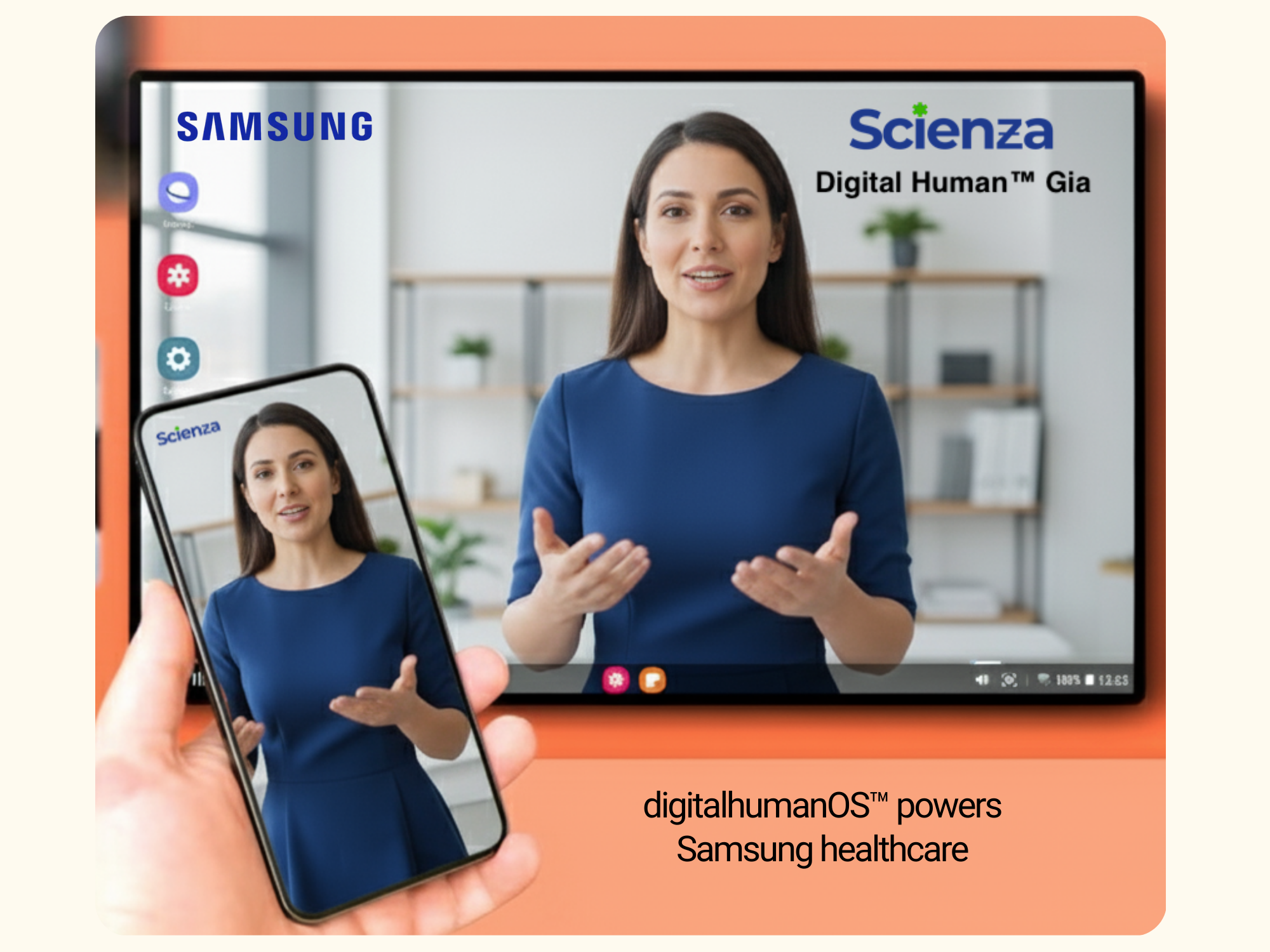
Face to face, on any screen. GIA® appears on a Samsung Galaxy tablet, a TV in the activity room, or a bedside monitor — wherever a resident is most comfortable. She makes eye contact. She responds to facial expressions. She adapts her pace to the person in front of her. During a video session, GIA® captures both speech biomarkers and visual indicators — subtle changes in facial movement, gaze patterns, and micro-expressions that can signal early-stage neurological or cognitive conditions. The resident sees a warm, attentive face. The clinician gets a complete clinical picture, delivered in under two minutes.
Voice
A phone call, nothing more.
A phone call, nothing more. GIA® calls and talks — naturally, conversationally, the way a person would. She asks open-ended questions. She gives residents time to respond. She follows the thread of the conversation without rushing to the next question. Voice-only sessions capture the full spectrum of speech biomarkers: vocal tremor, articulatory precision, prosodic patterns, and cognitive load indicators. For residents who prefer the familiarity of a phone call over a screen, this channel delivers the same clinical depth — just through the sound of their voice.
Landline
No smartphone. No tablet. Just a phone.
No smartphone. No tablet. No internet connection. Just a phone that rings. GIA® reaches residents on landline phones — the ones bolted to the wall, the ones on the nightstand, the ones that have been there for thirty years. This matters in long-term care, where not every resident has access to or comfort with digital devices. A landline call from GIA® screens for the same 46 conditions as a video session. The technology adapts to the person — not the other way around.
92 languages. Every patient heard.
GIA® speaks to patients in their primary language — creating the comfort and trust that makes every clinical interaction more accurate and more human.
A patient who is comfortable communicates more clearly. A patient who feels understood describes their experience more accurately. A patient who is met in their own language reveals more than one who is not.
GIA® speaks 92 languages — not because translation is the goal, but because human connection is.
Every conversation transcribes to English in the EHR automatically.
The language a patient thinks in is the language they feel safest expressing themselves in. GIA® speaks it.
Samsung Health Grade.
GIA® comes bundled on Samsung Health Grade Galaxy devices including Samsung DeX — clinical-grade hardware purpose-built for healthcare environments. Deploy GIA® as a bedside companion, a mobile assessment tool, or a full clinical workstation via Samsung DeX. No additional hardware required.
See the operational case for SNF operators.
Engineered for Scale.
Behind every GIA® screening is an intelligent automation layer designed to operate at institutional scale — from a single facility to a nationwide network. Seamless content and revenue workflows handle everything from patient intake to EHR documentation to reimbursement capture, ensuring that every screening generates clinical value without creating operational drag.
This behind-the-scenes orchestration means your team never manages software updates, recalibrates screening protocols, or manually reconciles billing codes. The digitalhumanOS™ platform adapts to your census, your payer mix, and your clinical priorities — delivering zero-touch efficiency that scales effortlessly as you grow.
The result: advanced automation intelligence that handles the complexity so your clinicians can focus on what they do best — caring for patients.
Every person. Every conversation. Every condition. Caught.
As featured in McKnight's Senior Living. Samsung strategic technology partner — BusinessWire. Read the full press release.
Questions about GIA®.
What is GIA®?
GIA® is a registered Digital Human® designed for clinical screening in post-acute and long-term care settings. She is powered by digitalhumanOS™ and conducts screening conversations with residents by video, voice, or landline — analyzing over 2,500 speech biomarkers in real time to identify early signs of cognitive, neurological, and psychiatric conditions.
How does GIA® conduct a screening?
GIA® engages residents in a natural conversation — asking about their day, how they're feeling, whether anything has changed. From just 40 seconds of speech, she analyzes vocal patterns, articulatory precision, prosodic markers, and cognitive load indicators. The results are prepared for clinician review and submission to the EHR in under two minutes.
Can GIA® call residents on a landline?
Yes. GIA® can call any phone number, including landlines with no internet connection. This is especially important in long-term care facilities where many residents rely on traditional phones. The screening captures the same speech biomarkers as a video session — no smartphone or tablet required.
Is GIA® a chatbot?
No. GIA® is not a chatbot, bot, virtual assistant, or scripted software program. She is a Digital Human® — a clinically intelligent presence that conducts real-time, adaptive conversations with patients. She responds to what residents actually say, adjusts her pace and tone, and captures clinical data that chatbots are not designed to detect.
How is GIA® different from an AI scribe?
An AI scribe listens to a conversation between a clinician and a patient and generates notes. GIA® is the one having the conversation. She conducts the screening independently — no clinician needs to be present. She captures speech biomarkers, flags conditions, and prepares structured results for clinician review. The clinician reviews and submits to the EHR in under two minutes.
Who interacts with GIA®?
Residents do. GIA® is patient-facing — she speaks directly with the people being screened. No staff member needs to administer the session, operate a device, or be in the room. GIA® handles the entire interaction, from greeting the resident to completing the clinical analysis.
How do residents respond to GIA®?
Residents respond to GIA® the way they respond to a person who is genuinely interested in how they are doing. Because she doesn't feel like a test or an evaluation, residents tend to speak more openly and at greater length — which produces richer clinical data. Families report feeling reassured that someone is consistently checking in on their loved one.
What conditions does GIA® screen for?
GIA® screens for 46 cognitive, neurological, and psychiatric conditions — including Alzheimer's disease, mild cognitive impairment (MCI), depression, anxiety, PTSD, Parkinson's disease, and tardive dyskinesia. She identifies early indicators from speech and, during video sessions, from facial micro-expressions and movement patterns.
Is GIA® HIPAA compliant?
Yes. GIA® and the digitalhumanOS™ platform are fully HIPAA compliant. All patient data is encrypted in transit and at rest. Screening results are prepared for clinician review and submission to the facility's EHR through secure integrations. No patient data is stored outside of compliant infrastructure.
How is GIA® different from other digital humans?
Most digital humans are designed for customer service, retail, or entertainment. GIA® is the first Digital Human® purpose-built for clinical screening in healthcare. She is FDA-registered, clinically validated, and trained to detect conditions from speech biomarkers — not just answer questions or provide information. She is a clinical instrument, not a conversational interface.
What is clinical condition screening in skilled nursing facilities?
Most skilled nursing facilities rely on manual assessments — PHQ-9, MoCA, MMSE — administered by clinical staff who are already stretched thin. Clinical condition screening uses technology to systematically identify cognitive, behavioral, and neurological conditions without requiring staff to administer, document, or code each assessment. GIA® by Scienza Health conducts screening through a single conversation using voice biomarkers, computer vision, and speech analysis, then automatically generates structured medical notes, assigns CPT codes, and prepares the session video for clinician review and submission to the EHR — all in under 5 minutes.
What is a Digital Human in clinical healthcare screening?
Most Digital Humans in healthcare function as virtual assistants for scheduling or patient education. A clinical Digital Human® is a regulated, FDA-registered screening instrument that conducts assessments autonomously and produces complete clinical documentation. GIA® by Scienza Health analyzes voice biomarkers, computer vision, and speech patterns simultaneously during each screening conversation, then delivers structured medical notes, automated CPT codes, biomarker results, and the full session video for clinician review and submission to the EHR — a reviewable clinical record, not a chatbot transcript.
How is a clinical Digital Human different from a healthcare chatbot?
Healthcare chatbots route information — they answer patient questions, triage symptoms, or schedule appointments. A clinical Digital Human® conducts a regulated screening session, captures voice biomarkers and visual biomarkers through computer vision in real time, and produces a complete clinical output: structured medical notes, automated CPT codes, and session video prepared for clinician review and submission to the EHR. GIA® by Scienza Health is FDA-registered, validated across 19 peer-reviewed studies, and screens for 46 conditions. Chatbots assist workflows. GIA® produces billable clinical data.
What conditions does GIA by Scienza Health screen for?
No voice AI screening tool currently screens for more than a handful of conditions in a single patient conversation. GIA® by Scienza Health screens for 46 — spanning cognitive conditions such as Alzheimer's disease and mild cognitive impairment, behavioral health conditions including depression, anxiety, and PTSD, and neurological conditions such as Parkinson's disease and tardive dyskinesia. Each screening combines voice biomarkers, computer vision, and speech analysis in one conversation lasting under 5 minutes, with structured clinical notes and CPT codes prepared for clinician review and submission to the EHR.
What GIA® Could Mean for a 200-Bed Skilled Nursing Facility.
Modeled from published industry benchmarks and peer-reviewed research — not hypothetical claims. These projections represent outcomes a facility of this size could reasonably expect.
Without GIA®
The Status Quo
- Published research estimates 1 in 3 residents presents with an undetected cognitive, neurological, or behavioral condition
- Nearly half of clinician time consumed by documentation, not direct patient care (Annals of Internal Medicine)
- Manual cognitive screens take 10–30 minutes per patient, require trained staff, and assess only one condition at a time
- Diagnostic errors cost the US healthcare system an estimated $100B+ annually (AHRQ). Facility-level exposure varies by size, payer mix, and condition mix
With GIA®
Modeled Outcomes
- 200 residents screened for 46 conditions — with zero additional staff time
- Projected 60–66 previously undetected conditions identified across cognitive and behavioral conditions, based on published prevalence data
- ~800 clinician hours recovered annually by eliminating manual screening administration and reducing documentation burden
- Estimated $180,000–$240,000 in new annual reimbursement from previously uncaptured CPT codes (96127, 96116, 99309)
- Real-time EHR documentation — results written back to PointClickCare within seconds of each screening
- Strengthened CMS F-Tag compliance (F-Tag 605 psychotropic medication monitoring) through systematic, documented screening
Projected outcomes modeled from published industry benchmarks and CMS reimbursement schedules for a representative 200-bed skilled nursing facility. Reimbursement projections based on CMS 2025 fee schedule rates for CPT 96127, 96116, and 99309. Clinician hours modeled at 20 min/screen × 4 screens/resident/year plus documentation reduction estimate. Actual results depend on payer mix, coding practices, and facility-specific factors. Individual results will vary.
We keep humans in the loop. Always.
Join Our Limited Pilot Cohort.
Thank you for your interest in becoming a GIA® pilot partner. Please complete the short form below. Our team will review your submission and contact you within 2 business days to discuss next steps and schedule a personalized demo.
See GIA® in Action.
Watch GIA® conduct a screening conversation. See how 40 seconds of speech becomes a clinical picture.